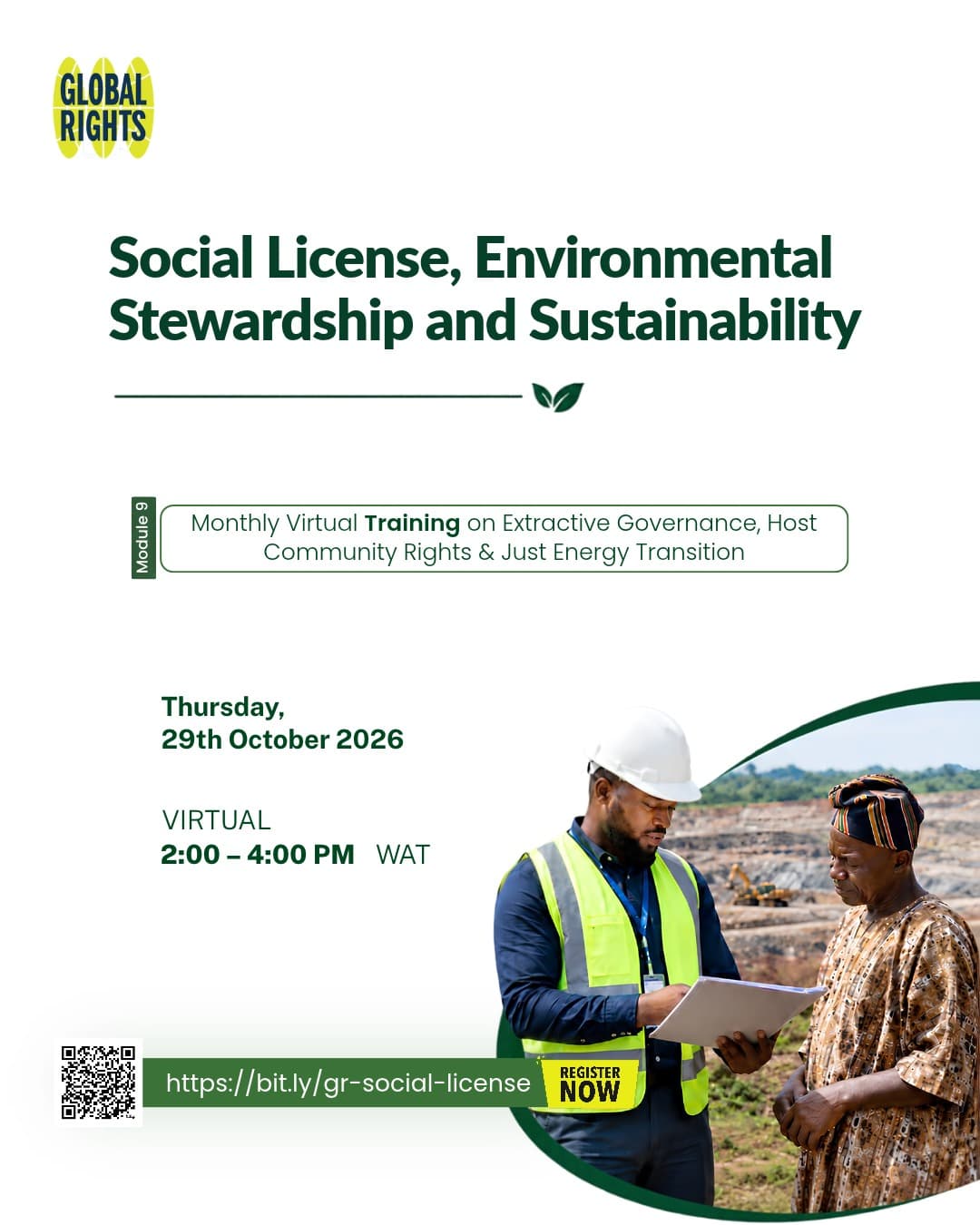
Social License, Environmental Stewardship and Sustainability
October 29, 2026 @ 2:00 pm - 4:00 pmVirtualModule 9
When the Mine Leaves, What Stays?
Social License, Environmental Stewardship and Sustainability in Mining Host Communities
Facilitator: Ms. Tengi George-Ikoli
Every mine will eventually close. The machines will be switched off, operations will cease, and the company may move on to the next resource-rich community. But what will remain? The land, the water, and the host community will live with the consequences of mining long after the company has left. Whether that legacy is a thriving community or a scarred landscape is determined long before closure. It is determined by how well the company plans its exit from the onset and how it treats its host communities throughout its operations.
A mining company may hold every permit required by law and still lack the one thing it cannot secure through paperwork alone: the trust and acceptance of its host community. A government can grant a legal license, but a community confers the social license to operate. In Nigeria, community engagement and consent are mandated within the legal framework governing mining but many stakeholder struggle to understand its parameters.
For many mining host communities, the promise of “development” is translated as polluted water, degraded farmland, rising living costs, structural violence, and loss of their autonomy. These realities raise difficult questions: Who determines whether a community has granted its social license? Can that license be withdrawn? What does environmental stewardship mean when mined land is never restored? When communities raise grievances, who listens—and who provides a remedy? What mechanisms exist to resolve conflicts fairly?
A social license to operate must be more than a box-ticking exercise or a corporate whitewashing strategy. It must be earned through action and sustained through accountability. It rests on meaningful community engagement and consent, built on trust and credible development commitments; environmental protection that goes beyond minimum legal compliance; and accessible, trusted grievance mechanisms that deliver genuine remedies. Ultimately, sustainability is the test: Will the community be better off when the mine closes than it was when mining began?
Join Ms.Tengi George-Ikoli, Nigeria Country Manager at the Natural Resource Governance Institute, for this month’s Protecting Mining Host Communities webinar. Building on our previous session on Free, Prior and Informed Consent (FPIC), she will explore what mining host communities should consider before consenting to a mining project—and what it takes for a company to earn, maintain, and be held accountable for its social license to operate.
In this session, Ms. George-Ikoli will unpack:
- Beyond legal permits: What a social license to operate means and why regulatory approval alone is not enough.
- Community development: What meaningful development looks like and how host communities can shape priorities and decisions.
- Environmental stewardship: What responsible environmental management requires before, during, and after mining.
- Grievance and remedy: How grievance mechanisms work and what makes them credible, accessible, and effective for affected communities.
- Sustainability beyond closure: How to measure lasting benefits and account for the environmental and social legacy left behind.
- Shared accountability: What communities, governments, mining companies, and civil society must each do to uphold and hold the social license to operate to account.
Whether this is your first session or you’ve been with us since Module 1, we invite you to participate in this important conversation.