There was a time when Maryam walked to school alone.
Her husband (Bamaiyi) would ride past her on his motorcycle without stopping. At home, decisions were made without her voice. Finances were hidden. Dreams were postponed. What they had was a house, but it did not feel like a home.
Today, that same couple owns livestock. They purchased land together. They save jointly. Their daughter is supported in nursing school. And the man who once kept silent now stands as an advocate for women’s inclusion in his community.
So what changed?
For many men, leadership has long been defined by control — providing, protecting, and making decisions alone. In many households and communities, this meant women carried influence without formal voice. Over time, that model created pressure, conflict, and fragile systems where decisions were made by only half the population.
In Northwest Nigeria’s border communities, insecurity is often discussed through conflict statistics. But it also appears in everyday decisions — in homes, justice systems, and community meetings where women are absent or unheard. When decision-making excludes half the population, both households and communities become more fragile.
Bamaiyi once believed leadership meant carrying everything alone — finances, responsibilities, decisions. The pressure grew, tension increased at home, and the household became unstable.
Through the Gender Action Learning Systems (GALS) training, he discovered a different model of leadership: partnership. Financial decisions became shared, responsibilities balanced, and conflict reduced. As stability grew at home, he began advocating for women’s participation in community peace and security discussions.
His transformation reflects the central objective of the broader intervention across Northwest Nigeria: to ensure that 50% of the population have meaningful participation in decisions affecting their security and quality of life.
This shift is not isolated. Across project LGAs, measurable change is underway.
What’s changing across Northwest Nigeria:
- Up to 88% of respondents report reduced violent conflict and improved safety
- 84.3% report improved experiences with the justice system
- Participation of women, youth, and persons with disabilities increased from 48% at baseline to 88.2% at endline
- Early Warning and Early Response mechanisms are actively preventing escalation
- Referral systems are strengthening access to legal support and formal justice institutions
In Sokoto State, women now play a central role in handling GBV-related cases within Community Development Committees. In one case, women constituted 85% of those who led the resolution process.
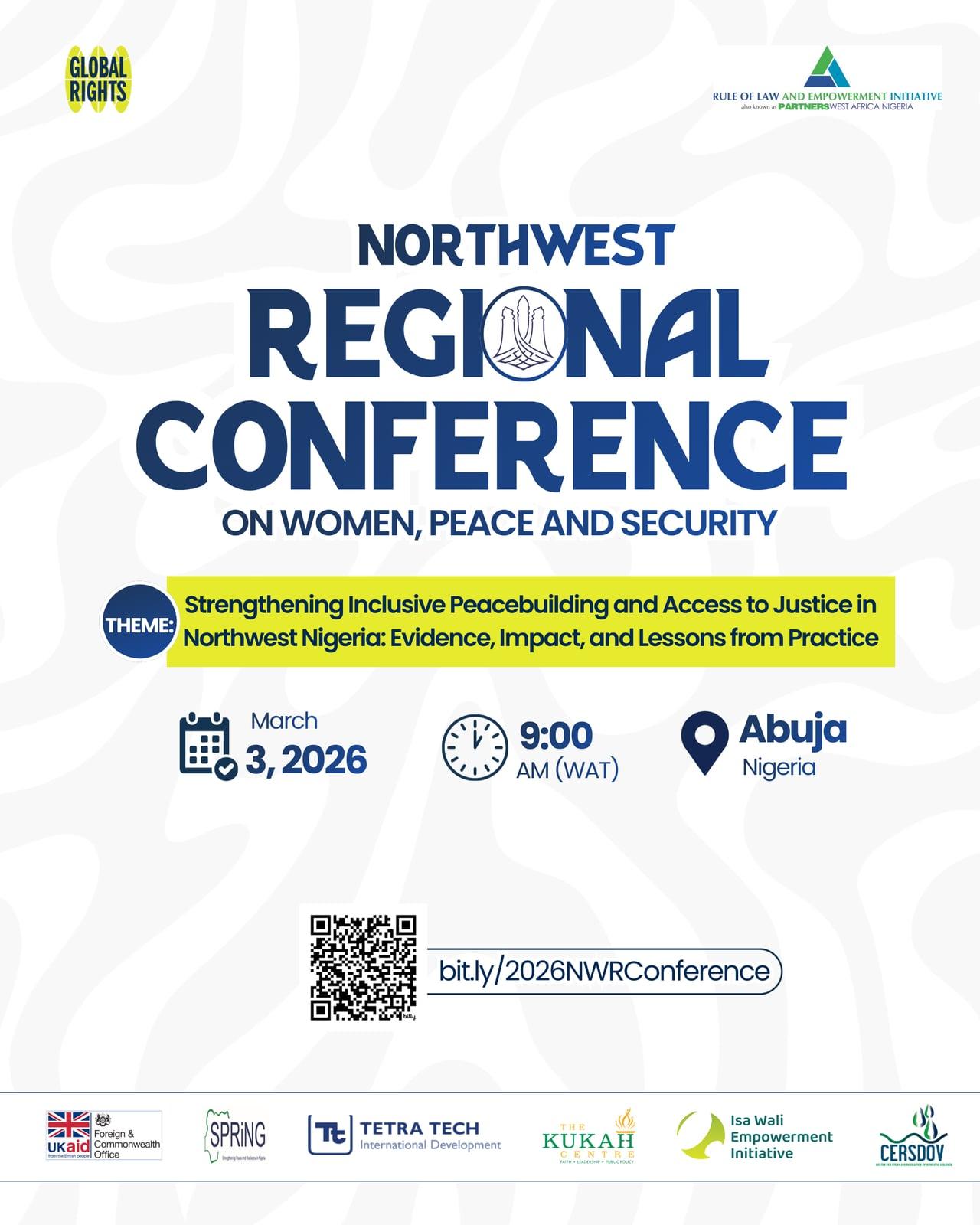
The lesson emerging from Northwest Nigeria is clear: security cannot be sustained when half the population is excluded from shaping it. As the current phase of the intervention concludes, the Northwest Regional Conference on Women, Peace and Security provides an opportunity to consolidate evidence and ensure these gains continue beyond the project lifecycle.
Because security carried by half the population is unstable.
Security shared by all is sustainable.
Now is the time to institutionalize these gains.