
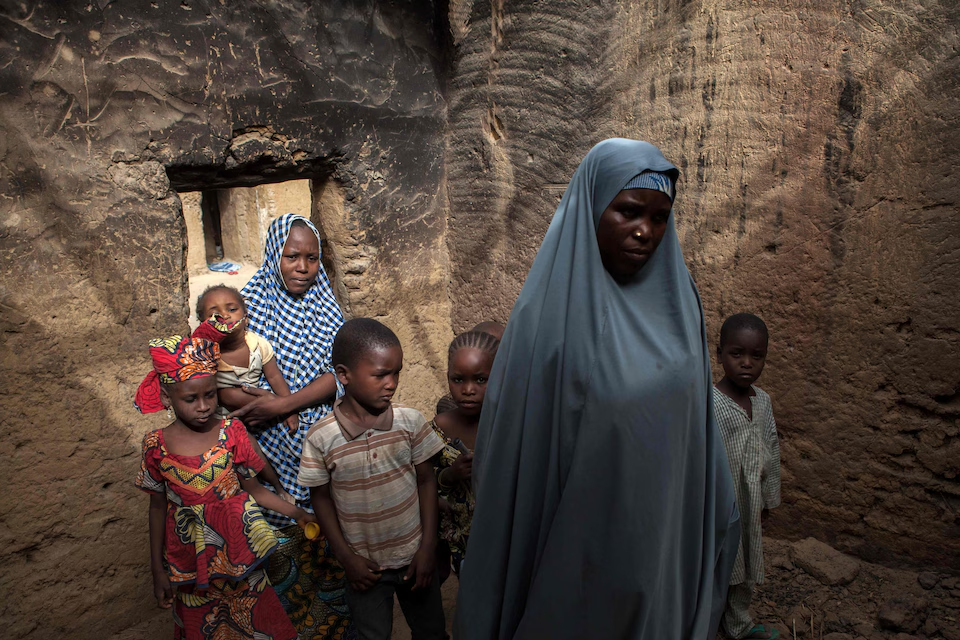
Eleven years ago, global outrage ignited the #BringBackOurGirls campaign following the abduction of 276 girls from their dormitories at the Government Girls Secondary School in Chibok, Borno State, Nigeria, by the terrorist group Boko Haram on April 14, 2014. Eleven years later, at least 91 of these 276 girls remain unaccounted for. Many were forcefully married to their captors, some died, and the insecurity that had marked Northeast Nigeria has metastasized and spread across the North-West and North-Central of the country. The South-East and South-South have also not been spared.
What Does Reintegration Look Like?
“Sometimes, I cry when I remember. I ask myself: ‘Why did I even leave Sambisa to come back to Nigeria, only to come and face such degrading treatment, being insulted almost daily?’ I never experienced such heartache while I was in Sambisa.” – A Chibok Girl Survivor/Returnee
The Chibok girls who managed to escape or were rescued and returned to their families cannot be described as fortunate. Many now bear permanent psychological scars. Deep-rooted trauma, the children they bore in captivity, and the stigma they faced upon their return to their communities are constant reminders of the horrors they lived through and continue to live in. Their reintegration has remained an uphill battle years after their return. Apart from the stigma, they lack access to long-term psychosocial support and rehabilitation. Most of them did not complete their education and have no marketable skills.
What has changed in the past 11 years?
The kidnapping of the Chibok girls was not an isolated incident. Since the incident in April 2014, Nigeria has recorded at least 37 incidents of mass kidnappings of students, with more than 2,138 students across the country. Despite efforts like the Safe Schools Initiative, launched in the wake of the Chibok abductions, little has changed. In 2015, the Nigerian government, supported by international partners, had pledged to invest $20 million to secure schools in Nigeria. Despite promising a more secure future for Nigerian children, it was stalled for many years. To give life to the government’s promise, ₦144.8 billion was again earmarked for the initiative in 2022. Again, there has been little evidence that this has translated into tangible protection for students. Parents continue to fear sending their children to schools in northern Nigeria for fear of being targeted by extremist groups. Their fears are justified. Nigeria’s schools have remained easy targets for violent extremist groups, and recent kidnappings in Kaduna, Sokoto, and Zamfara have only proven that the country’s education system remains perilously unsafe. According to a vulnerability assessment by the Nigeria Security and Civil Defense Corps (NSCDC), 80% of Nigerian schools are still vulnerable to attacks. Only 528 schools were registered by the National Safe Schools Response Coordination Centre (NSSRCC), a negligible ratio of more than the 81,000 registered schools across the country.
Currently, there are more than 20 million out-of-school children across Nigeria; many of them are located in the north, where most of these kidnappings occur. The government has continued to fail to prioritize education and other human development indicators at the expense of the country’s future.
The tragic story of the Chibok Girls remains symbolic of a much larger, systemic failure of the state to protect its most vulnerable. The sustained #BringBackOurGirls movement continues to echo as citizens’ protest their government’s failure to fulfil its Constitutional duty of ensuring their “welfare and security” (Nigerian Constitution S14(2)(b)).
Today, we solemnly commemorate the 11th anniversary of the Chibok girls’ abduction and of the less publicized Buni Yadi massacre in which 59 students of Federal Government College Buni Yadi in Yobe State were killed at their school in a terror attack on February 25, 2014. We commiserate with them and their families. But as importantly, we call YOU to action. We must honor their sufferings by fighting for the future of other children and demanding accountability for the missing, survivor-friendly response for returned girls, and protection for the millions of Nigerian children still at risk. Nigeria’s government must ensure the safety of schools and protect children’s rights. They must ensure that every Nigerian child can pursue the future they dream of.
We cannot wait another decade for justice. We cannot afford another generation to grow up in fear. The fight for the Chibok girls is the fight for every Nigerian child.
Today, we remember.
Written by: Blessing Obi.
(Blessing Obi is an intern at Global Rights)